The principle and description of polarization
~Understanding polarization states derived from electromagnetic wave equation~ ... (PL)
Polarization is a phenomenon determined by how the electric field vector of light vibrates. This article carefully explains, with mathematical formulas, how polarization is generated and described, using the wave equation of electromagnetic waves (EM1) as a guide.
table of contents:
-
Description of elliptic polarization due to the p/s polarization component of electromagnetic waves incident on the interface
・Description of elliptic polarization using the p/s polarization component
In a scenario where electromagnetic waves are incident on an interface, when the plane containing the normal to the interface and the incident light is defined as the plane of incidence, the component of the electric field that vibrates parallel to the plane of incidence is defined as p-polarized light, and the component of the electric field that vibrates perpendicular to the plane of incidence is defined as s-polarized light. This can be illustrated as follows.

In this case, any electromagnetic wave incident on the interface can be described as the sum of p-polarized and s-polarized waves, as shown below.

Here, we define the unit vector of the amplitude vector as follows.

However, the absolute value of the amplitude vector extends the concept to complex numbers as follows (this is called the complex amplitude). This is to describe the amplitude in a way that includes the relative phase difference δ between p-polarization and s-polarization.

Using this, (1)-②a,b can be rewritten as follows.

Let the scalar components (i.e., the coefficients of the unit vectors) of (1)-② a',b' be as follows.

Furthermore, the real part of (1)-⑤a,b is set as follows.

Transforming (1)-⑥a results in the following:

Substituting (1)-⑥b into this, the position vector and time are eliminated, resulting in the following:

Squaring both sides, we finally obtain the following equation.

This represents an elliptical shape and shows the trajectory of the tip of the electric field vector over time as it changes at an arbitrary position vector.
Especially,
[i] When δ = 2m × π (where m is an integer),

This represents a straight line, so it is called linear polarization.
[ii] When δ = (2m + 1) × π (where m is an integer),

This also represents a straight line, so it is called linear polarization.
[iii] When δ = (m + (1/2)) × π (where m is an integer) and Es = Ep = E,

This represents a circle with radius E, and is therefore called circularly polarized light.
・Derivation of the rotation angle and ellipticity of an ellipse
Here, the elliptical shape of (1)-⑦' is assumed to be the same as the elliptical shape shown below, rotated by an angle γ with respect to the origin (counterclockwise direction is considered positive).

However, 𝑎 and 𝑏 denote the semi‑major (or semi‑minor) axis and the semi‑minor (or semi‑major) axis of the ellipse, respectively, and both take positive values.
Furthermore, the ellipticity χ is defined by the following equation.

The relationships shown so far can be illustrated as follows:
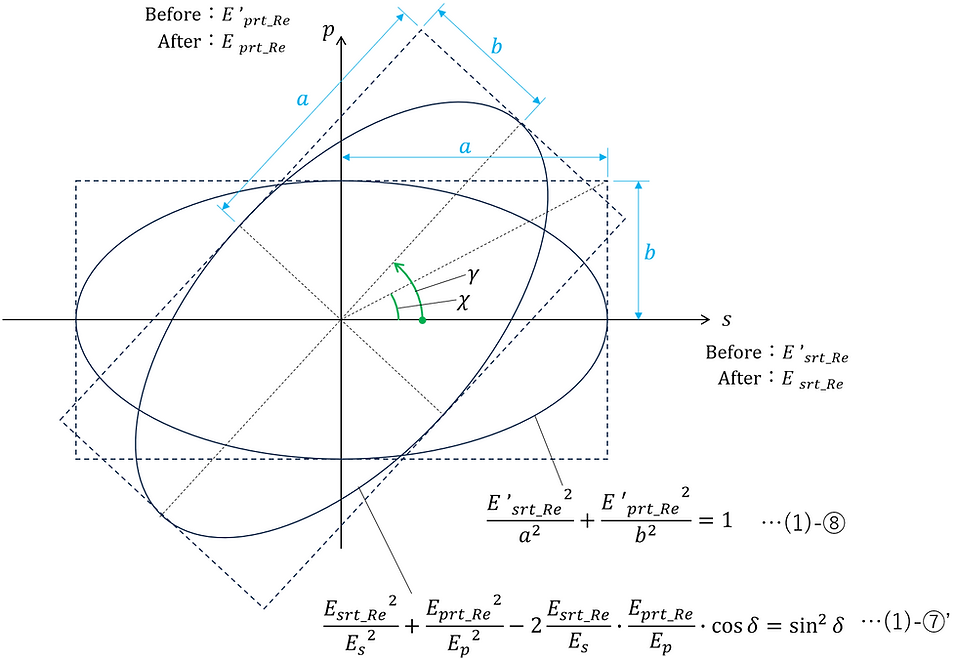
Here, γ is an angle with a direction where counterclockwise is positive, and χ is a positive angle with no direction.
The relationship between (Esrt_Re , Eprt_Re ) and (E'srt_Re , E'prt_Re ) can be expressed as follows:

Substituting (1)-⑩ into (1)-⑦' and rearranging, we get the following:

(1)-⑧ and (1)-⑪ are the same,

From (1)-⑪b and (1)-⑫b,

From (1)-⑨, (1)-⑪a,c, and (1)-⑫a,c, the following is obtained.

Here, we will use the following relationship.

Substituting these into (1)-⑭ and rearranging, we get the following:

Here, from (1)-⑬, cos2γ can be expressed as follows.

Substituting this into (1)-⑭' and rearranging, we obtain the following:

Also, since a and b are positive values, tanχ is a positive value from (1)-⑨, and tanχ can be found from (1)-⑭'' as follows.

Generally, ellipticity is expressed in the form sin2χ, and from (1)-⑭'' and (1)-⑭''', the following equation is finally obtained.

Here, the compound terms that appeared along the way are reduced to the same equation through subsequent calculations.
-
Related literature
[A] Inoue, K. & Nakajima, S., Optics, Kyoritsu Publishing
[B] Tanaka, T., Introduction to Optics, Shokabo Publishing
[C]Max Born & Emil Wolf, Principles of Optics, Cambridge University Press
-
Update History
-
2026-06 Newly released.